Dear readers I apologize. As regular visitors have most likely already noticed, there has been somewhat of a drought in the Gource’s activity this past week. This can be attributed to a number of reasons, none of which are an increase in the rational thought of the world. The Army of Reason’s fight continues. While I can’t speak for other contributors, my higher priorities were nothing if not noble: Christmas shopping, angry letters to store owners, reading books about science, etc. However, there is one important commitment that has been eating up a lot of my time: the publication of my autobiography. That’s right loyal masses; soon my life can be words for your eyes to devour so that your brain will bestow upon you the kind of euphoria many a junkie has died trying to amplify.
My book will not kill you.
My book will serve as a useful guide to living the kind of life that rational thought and a love for God dictates – in fact, so much is evident in the title alone:
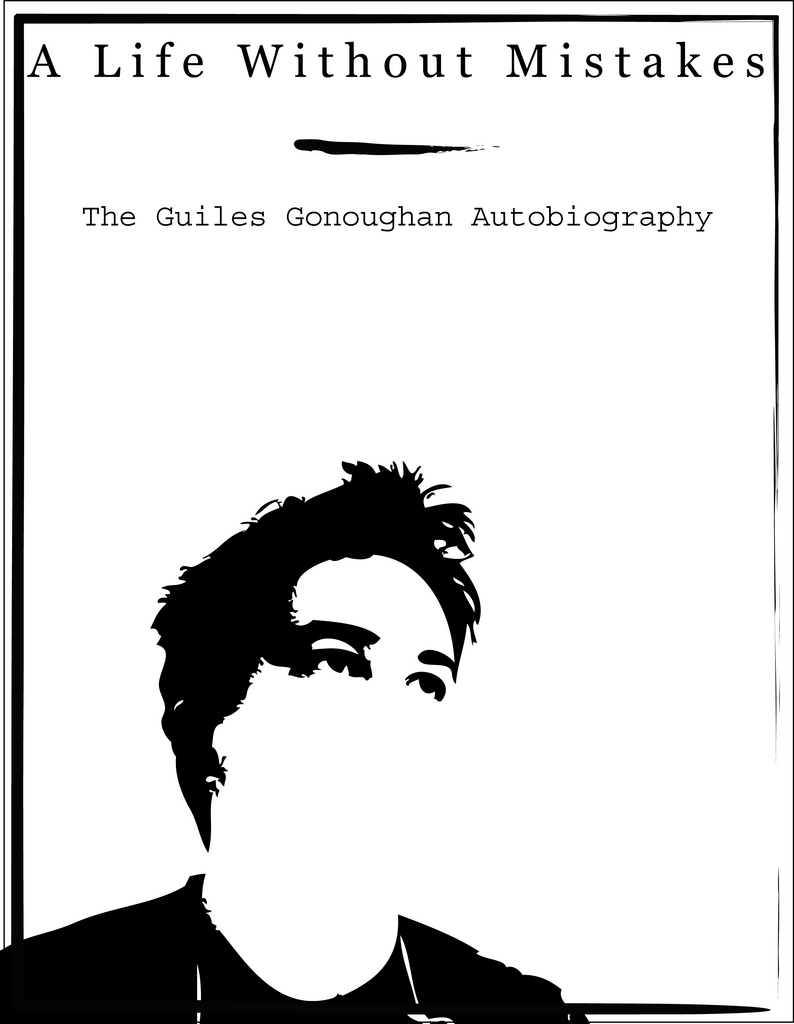
While it might be some time before the book is ready for publication and distribution I will do what I can to slake what I imagine is an incredible and universal thirst the world has to read what I’ve lived by occasionally sharing snippets from the work. The first can be found immediately beneath this sentence.
Chapter 1 – Wherein I Arrive and Have a Childhood
I was born on a Sunday – the best day to be birthed, if you ask me. It was early in the morning when the Lord saw fit to admit me to this world. I have heard from those present on that day that I was born with my eyes open, ready to look upon this realm and to solve its problems. Many doctors have assured me that this is impossible due to numerous medical facts, but I know that doctors are, for the most part, not to be trusted. My father told me that soon after my arrival he glanced out the window, overcome with joy and wonder. To hear him tell it the sky was ablaze that morning, it being the glorious period when the sun is just cresting the horizon, throwing shadows and sparks while the moon is still visible above it. Some people call this time of morning lunar dawnset, others call it rush hour. There’s one thing everyone agrees on though: that moment on that morning was one in which the world took a very serious step in the right direction.
My childhood was a brief one, as childhood is, by and large, a useless period in a human’s life. Children are capable of very little beyond simple arithmetic and fouling up the pronunciation of numerous basic English sounds, and so I did not feel compelled to devote much of my lifespan to being an incapable waste of resources. Sure, I spent my time in elementary school catering to the foolish whims of the passionless middle-aged women who filled the role of primary caretaker of the students in the Gohnson County school district between the hours of 9 a.m. and 3 p.m., but all the while I was fixated on the future. By age six I had formed a blueprint for my life – one without mistakes – and I can honestly say that so far I have proven myself right about everything time and time again. Throughout the course of this work my plan (henceforth referred to as The Plan) will be made more apparent, and as a result readers of this book will be able to form their own The Plans. Every plan needs a key objective, and I recommend you come up with yours as soon as possible. That’s how I started mine. The Plan’s key objective? Vanquish all foes.
I vanquished my first foe at the age of ten, in the bloodiest conflict Goover Elementary had ever seen. You see, in fourth grade a new student joined the ranks of my “peers” at Gherbert Goover Elementary, one of America’s Perfect Public Schools. But this new student was not perfect – in fact he was severely flawed. His name was William Donaldson, and he fancied himself precocious. There are few things I loathed more as a child than other children who considered themselves above the level of their classmates. Frequently these children were the result of parents with expensive but useless degrees, usually in fields like law or medicine. Let me say, for the record, that my parents’ degrees are of a much more respectable nature: my father has a Master’s in hard work, and my mother a PhD in integrity. “Those aren’t real degrees,” the deans of a number of institutions might argue. Here’s the thing: those deans all have degrees in shit-dickery.
But back to William Donaldson. The day he came into my life was one of the most glorious of my childhood. Why? Because, it was the day that I first received an enemy. At first I thought that, perhaps, Will and I might be friends. He excelled at reading, and was an impeccable speller. He held a similar amount of disdain for his classmates as I did, but for different reasons. But he didn’t know science, and he didn’t go to church. The first trait was evident every day immediately after recess, when our teacher would have us read and do exercises from The World is Mostly Explainable, our science textbook that left room for the possibility that a number of things about the planet were the result of some serious omnipotence. Will was always fouling up his science assignments – he didn’t know his sedimentary from his igneous, if you know what I mean. My knowledge about his religious handicap was obtained even more directly: I invited him to attend church with me. This was, of course, before I knew better than to give people the benefit of the doubt. I’d decided that, despite his inability with the most important subject that is taught in public school, Will might excel in the most important one that isn’t. It was one of the few times I’ve had an incorrect notion.
One Friday during lunch I approached Will, and did my best to behave personably. I explained that I’d deemed him a suitable friend candidate, and wanted to know if he would be interested in attending the services at the church my family was part of that coming Sunday. His answer nearly made me sick: he didn’t go to church. I was floored – never had I run across such malevolence, and in my own cafeteria. I calmed myself though, I proceeded cautiously and asked him to explain, and he obliged. He described how he had never attended church before because his parents weren’t particularly religious, and then he spoke the words that I’m sure he would come to look back on as being his own death knell: “I don’t believe in God.” That was it – I had to act.
My first order of business was to maintain my composure, as I wanted to keep the upper hand in the situation. Calmly I finished my Coke (I always brought my own lunch, and on Friday’s my mother included with it a bottle of the world’s best soda. A glass bottle). I continued talking to Will as if nothing were amiss, and we slogged through the mundane topics of pee-wee soccer, action figures, and how rotten it was to have to go to bed before 10 p.m. After an interminable amount of time lunch was over, and we were released outdoors to enjoy recess. I knew that I would have my best opportunity to destroy this abomination then, behind the playground and beyond the watchful gaze of Mrs. Krumleigh, but in full view of the Lord. I convinced Will to follow me to that secluded area of the grounds using a clever ruse that works on any male child of a low intellect: I told him there was a dead animal to be seen. He was a lamb to the slaughter.
When we reached the location of the corpse I’d promised Will became suspisicous. Fortunately he didn’t remain so for long. As he began to form a question (he got as far as “Hey, where’s th-“) I removed from my pocket the empty glass Coke bottle I’d saved from lunch and brought the bottom of it down on the bridge of his nose so hard I felt the continent move.
“Listen,” I said to him, “There’s something you should know.” He responded by crumpling to his knees and letting out a pitiful moan followed by a couple gasps as his nose had now become quite useless as far as breathing was concerned. “The Bible got a lot of things right,” I continued, speaking slowly and clearly to make sure that he could hear me through his pain. “But I am not one to live and let live.” He stared up at me, eyes widening. I told him to calm down, that I couldn’t take his life, as I wanted to get some kickball in before the end of recess. “But know this,” I said, kneeling down to stare him down, eye to eye. “When the final trumpet blows it’s going to be the people like me – the Guiles Gonoughans of the world – who come out on top, in life and in the afterlife. Isn’t it time you accepted the Lord?” For a fleeting second Will’s facial expression flickered, from misery to confusion. He didn’t get it. I swung my foot with mechanic accuracy, my toe connecting squarely with his forehead, and he was out.
The next day I was brought into the principal’s office and questioned about the splendidly broken nose that Will had been sporting since our conversation on the schoolyard. Apparently after regaining consciousness he simply wandered home, and nobody at the school knew anything about it until the following day. I explained to principal Joylend that Will and I were close friends, and that he’d discussed with me his godlessly abusive parents. The principal, due to misguided beliefs about the physical capabilities of a fourth grader, was inclined to believe that I could not possibly have been the one to deal such damage to dear Will, and by 5 p.m. that evening social services had placed Will into foster care as a result of a concerned phone call from himself and the district’s superintendent. And who should the patriarch of Will’s foster family be but none other than Reverend Nick Matherton, the man whose sermons I enjoyed every Sunday morning.
Hopefully you had the good sense to enjoy that. I plan on continuing doing regular grouses in the coming weeks, though there might be a marked decrease in their frequency given the season and the times. I can’t say when the next autobiography update will come – I know you will all be clamoring for it, but I’d really rather just get the publishing process underway so that you will have the pleasure of being able to read it in its entirety. Until next time, Gource fans.


 The Yankees were forced to sell six-time All-Star Ewell Blackwell to Kansas City to make room for colored player Elston Howard. A heartbroken Blackwell was pushed into retirement and spent the last years of his life in a lunatic asylum.